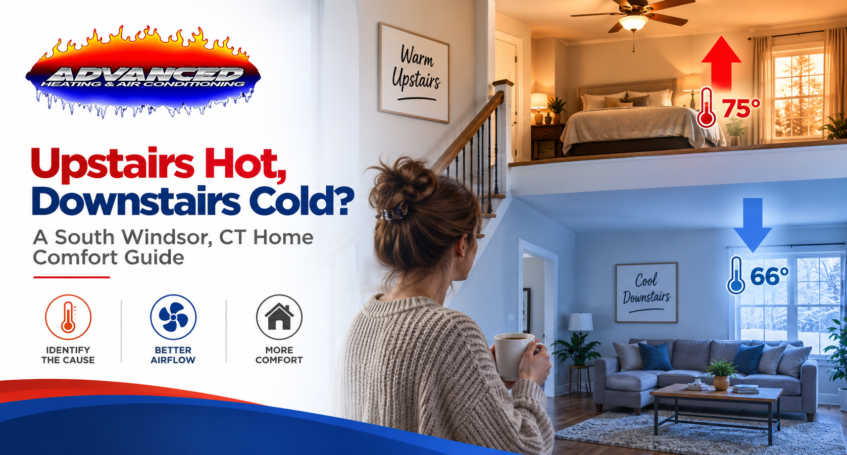
Upstairs Hot, Downstairs Cold? A South Windsor, CT Home Comfort Guide
You set the thermostat to a comfortable temperature, but when you walk upstairs, it feels noticeably warmer. During winter, the opposite may happen: one floor feels comfortable while bedrooms or other areas stay colder than expected. Uneven temperatures are common in multi-level homes, but they can also be a sign that the home’s heating and cooling system is not distributing conditioned air as effectively as it could.
Understanding why this happens is important because home comfort is about more than the number displayed on the thermostat. Airflow, insulation, ductwork, sunlight, system design, and even the thermostat’s location can influence how each room feels.
Why Upstairs Rooms Often Feel Warmer
Warm air naturally rises, which is one reason upper floors can feel hotter. During summer, the problem can become more noticeable because the roof and attic receive direct sunlight for hours. Heat can build up above upstairs rooms and affect indoor temperatures.
Meanwhile, a thermostat located downstairs may sense that the first floor has reached the desired temperature and tell the cooling system to stop. The upstairs rooms may still be warmer.
This does not automatically mean the HVAC equipment is failing. It means homeowners need to look at the house as a complete system rather than focusing only on the thermostat.
Airflow Can Make a Big Difference
Your HVAC system needs to move conditioned air effectively throughout the home. When some rooms receive strong airflow and others receive very little, temperature differences become much more noticeable.
Blocked registers, ductwork problems, dirty filters, or an unbalanced system may contribute to airflow issues. Furniture or rugs covering supply or return vents can also affect circulation.
A company such as Advanced Heating and Cooling works with central air conditioning, heating systems, heat pumps, ductwork and other home-comfort equipment, so evaluating the complete system can help determine where a comfort problem may be coming from.
Your Home’s Insulation Also Matters
Sometimes the HVAC equipment gets blamed when the bigger problem is how the house holds onto conditioned air.
Poor attic insulation, air leakage around windows and doors, or other gaps in the building envelope can allow outdoor temperatures to influence certain rooms more than others. Upstairs rooms under a hot attic, for example, may gain heat faster during summer.
That means an HVAC system may be running properly but still struggle to create even comfort if one part of the house gains or loses heat much faster than another.
Ductwork May Not Be Delivering Air Evenly
In a ducted system, the route air travels matters. Rooms farther from the air handler may receive different airflow than rooms closer to it. Duct size, layout, leaks, restrictions, and balancing can all influence how much conditioned air reaches each space.
This is why simply turning the thermostat lower may not solve an upstairs comfort problem. It could make the downstairs colder while the upstairs remains uncomfortable.
If temperature differences continue despite normal thermostat settings and basic maintenance, homeowners searching for the best HVAC company in near Tolland may want to have the system evaluated rather than repeatedly adjusting the temperature.
Is Your Thermostat in the Right Place?
A thermostat can only respond to the temperature it senses around itself.
Imagine a thermostat located in a shaded first-floor hallway. That area may remain comfortable while a sunny upstairs bedroom becomes much warmer. The thermostat does not know how the bedroom feels unless the HVAC setup includes additional controls or zoning capabilities.
This is one reason modern comfort systems may offer more flexible temperature management. Advanced Heating and Air Conditioning, for example, lists an optional zoning system that can provide room-by-room comfort control with compatible equipment.
Sunlight and Room Location Can Change Comfort
Two rooms on the same floor can feel completely different.
A bedroom with large west-facing windows may receive strong afternoon sun, while another room stays shaded. Rooms over garages can also behave differently from spaces surrounded by conditioned rooms.
Before assuming there is a major HVAC problem, notice when and where the temperature difference occurs. Does the room become hot only in the afternoon? Is it uncomfortable all day? Does the issue happen during both heating and cooling seasons?
Patterns like these can provide useful clues.
Could the HVAC System Be the Wrong Size?
Bigger HVAC equipment does not automatically mean better comfort. A system needs to suit the home’s size, layout, insulation characteristics and other factors.
If equipment is not well matched to the home, comfort problems may occur even when the system technically heats or cools.
Older homes can present additional challenges because their layouts or duct systems may have been designed before modern comfort expectations or later renovations. Finished basements, additions, converted attics and remodeled rooms can also change the heating and cooling needs of a property.
When Should Uneven Temperatures Be Investigated?
A small difference between floors may simply be part of how a particular home behaves. But large or persistent differences deserve attention, especially if they are accompanied by weak airflow, unusually long system operation, frequent thermostat adjustments or rooms that rarely become comfortable.
The goal should not be to immediately replace equipment. A proper evaluation should first consider airflow, ductwork, insulation, thermostat location, equipment condition and the way the home is being used.
Final Thoughts
An upstairs-hot, downstairs-cold problem rarely has one universal explanation. It can result from natural heat movement, sunlight, insulation, duct design, airflow, thermostat placement or the HVAC system itself.
For Tolland homeowners, understanding these factors is the first step toward solving the actual problem instead of simply lowering or raising the thermostat.
A comfortable home should work as a whole. When temperatures vary significantly from room to room or floor to floor, finding why they differ is often more useful than simply asking the HVAC system to work harder.